Asia/Kolkata
BlogMay 4, 2026

I Ran a 4.5 Billion Parameter AI Model on a Phone. No Cloud. No API Keys. Here's How.

Sumit Vairagar
I Ran a 4.5 Billion Parameter AI Model on a Phone. No Cloud. No API Keys. Here's How.
Last week, I asked a 4.5 billion parameter AI model "What's the weather in Tokyo?" — and it called a live weather API, parsed the response, and gave me a formatted answer. All running on a phone. No cloud. No API key. No data leaving the device. This isn't a Google I/O demo. It's an open-source Flutter app I built called EdgeAI Kit. Every time your app sends user data to OpenAI or Google's API, you're taking on risk:
  • Privacy regulations — HIPAA, GDPR, and your enterprise clients always asking "where does our data go?"
  • API costs — Per-token pricing adds up fast at scale
  • Latency — Round-trip to a server adds 200-500ms minimum
  • Availability — No internet? No AI. Unless it runs locally.
On-device AI eliminates all of that. The model runs on hardware your users already own. Think about the use cases:
  • Healthcare apps processing patient notes without HIPAA cloud headaches
  • Finance apps analyzing documents without data ever leaving the device
  • Enterprise tools that work in airplane mode, in secure facilities, offline
  • Zero per-token API costs — forever
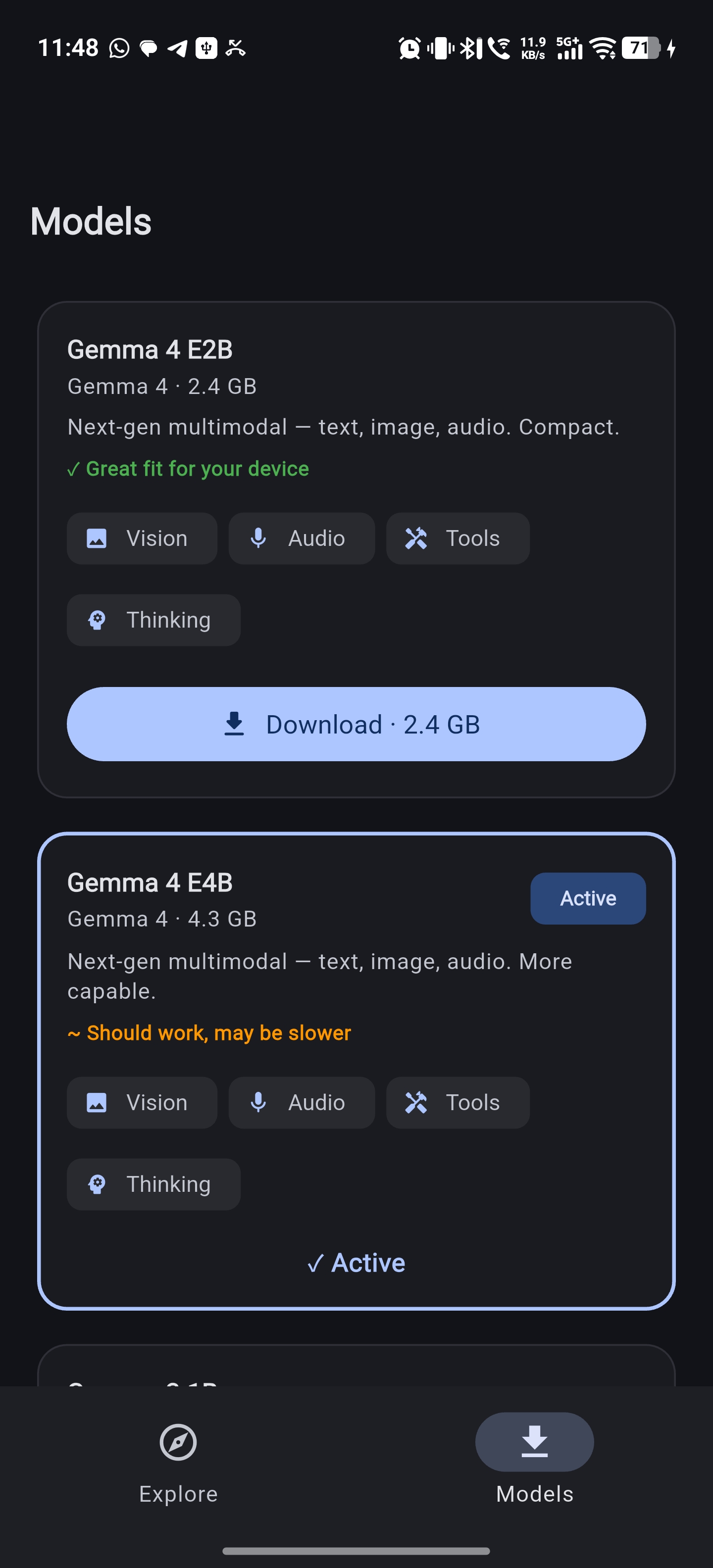
EdgeAI Kit is a Flutter toolkit that makes on-device AI practical, not just possible. Here's what it does: The app scans your device hardware and tells you which models will run well. Gemma 4 E2B (2.4 GB) gets a "Great fit for your device" badge. Gemma 4 E4B (4.3 GB) gets a "Should work, may be slower" warning. No guessing.
Model catalog showing Gemma 4 variants with capability badges
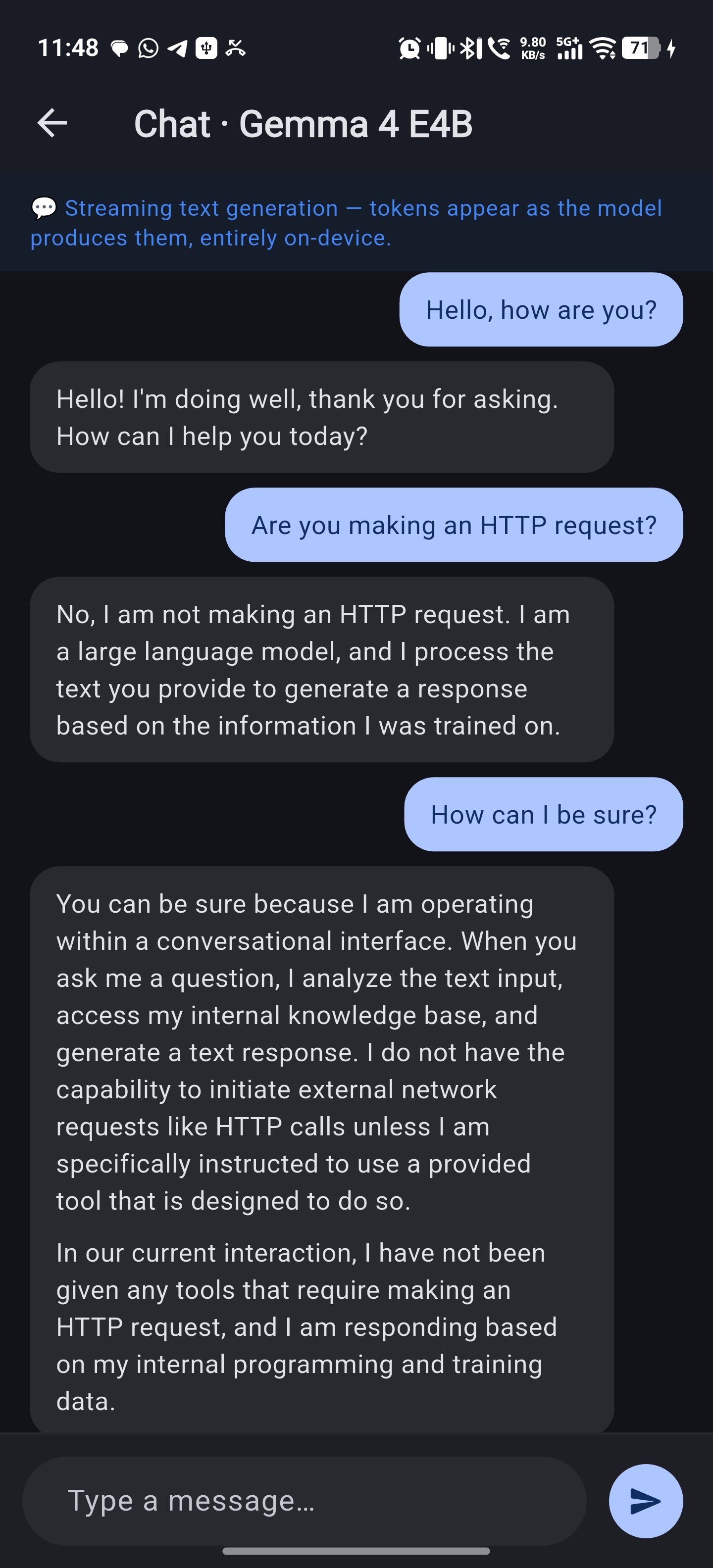
Seven models are ready to download: Google Gemma 4, DeepSeek, Qwen, Phi-4, and more. Each shows its capabilities — Vision, Audio, Tools, Thinking — so you know exactly what you're getting. Once a model is downloaded, you can chat with it. Tokens stream in real-time as the model generates them — entirely on-device. I tested this by asking the model "Are you making an HTTP request?" and it confirmed: no network calls, no external access, pure local inference.
On-device chat with Gemma 4 showing streaming responses
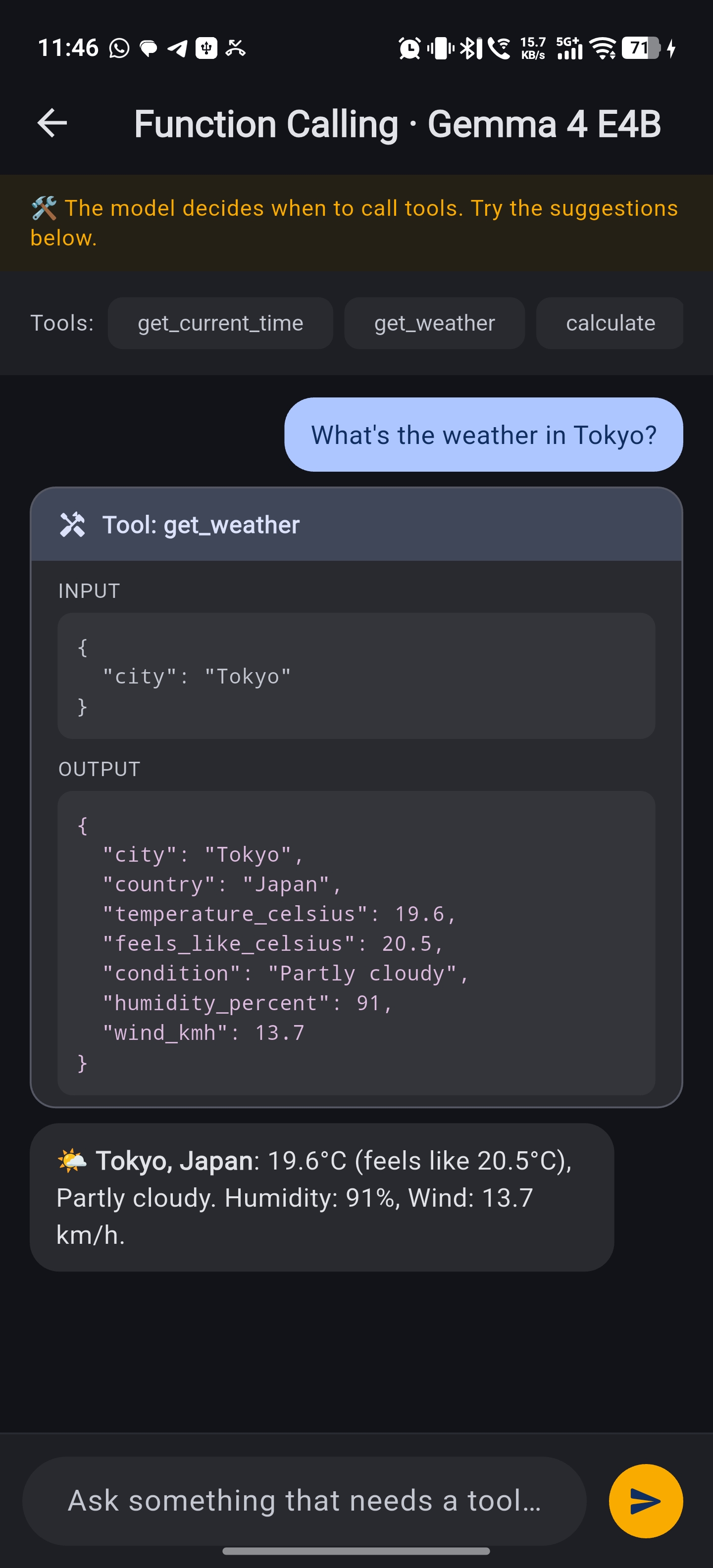
This is the part that surprised me most. The AI model can call real tools. I defined three tools — get_current_time, get_weather, and calculate — and the model decides when to use them. Asked "What's the weather in Tokyo?" and Gemma 4 autonomously called the weather tool, received the JSON response, and formatted a human-readable answer. All on-device except the actual weather API call.
Function calling — AI model calling get_weather tool on device
This opens up serious possibilities: on-device AI agents that can interact with local databases, device sensors, or selective APIs — while keeping the reasoning entirely private. No hand-waving about performance. The built-in benchmark runs a standard prompt and measures actual throughput:
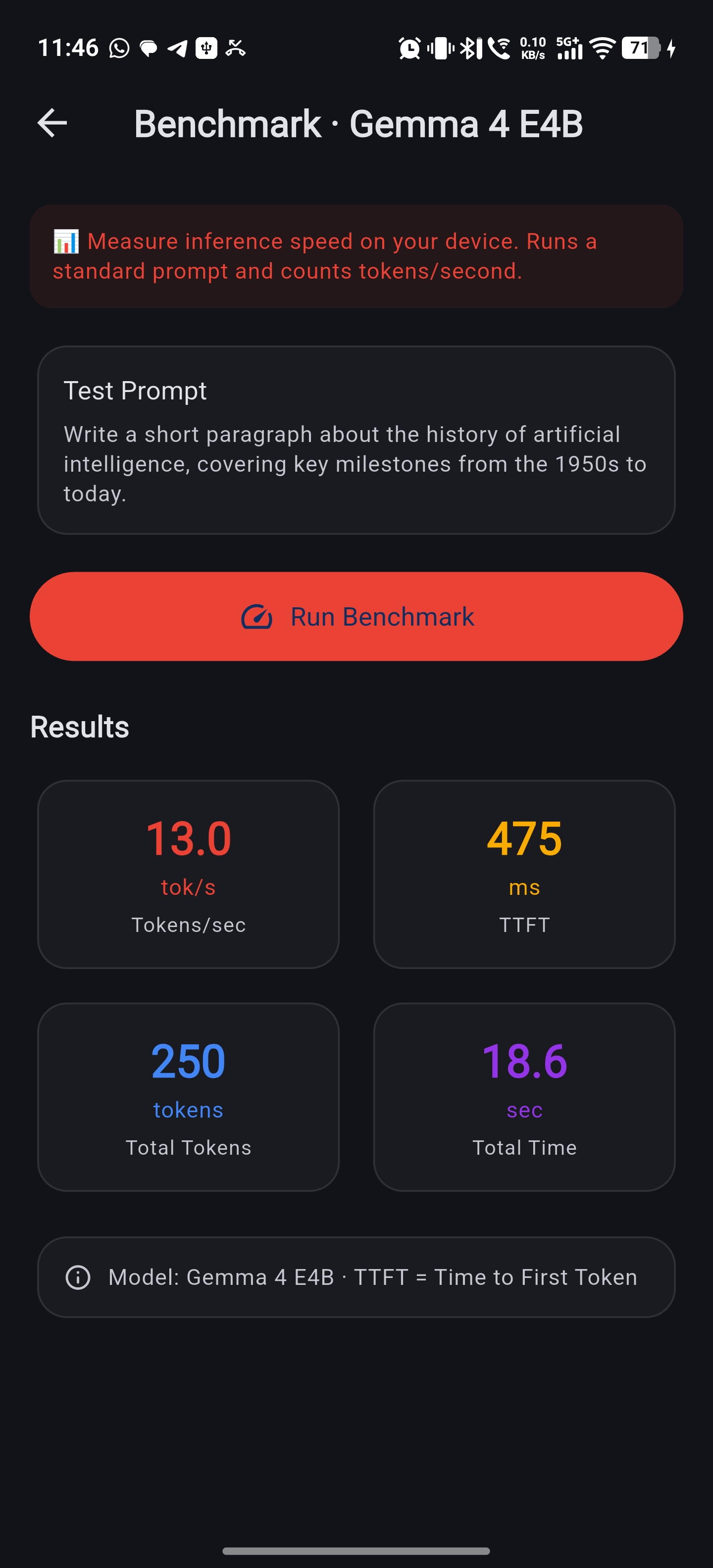
Benchmark results: 13 tokens/sec, 475ms time to first token
  • 13.0 tokens/second on a mid-range phone
  • 475ms time to first token
  • 250 tokens generated in 18.6 seconds
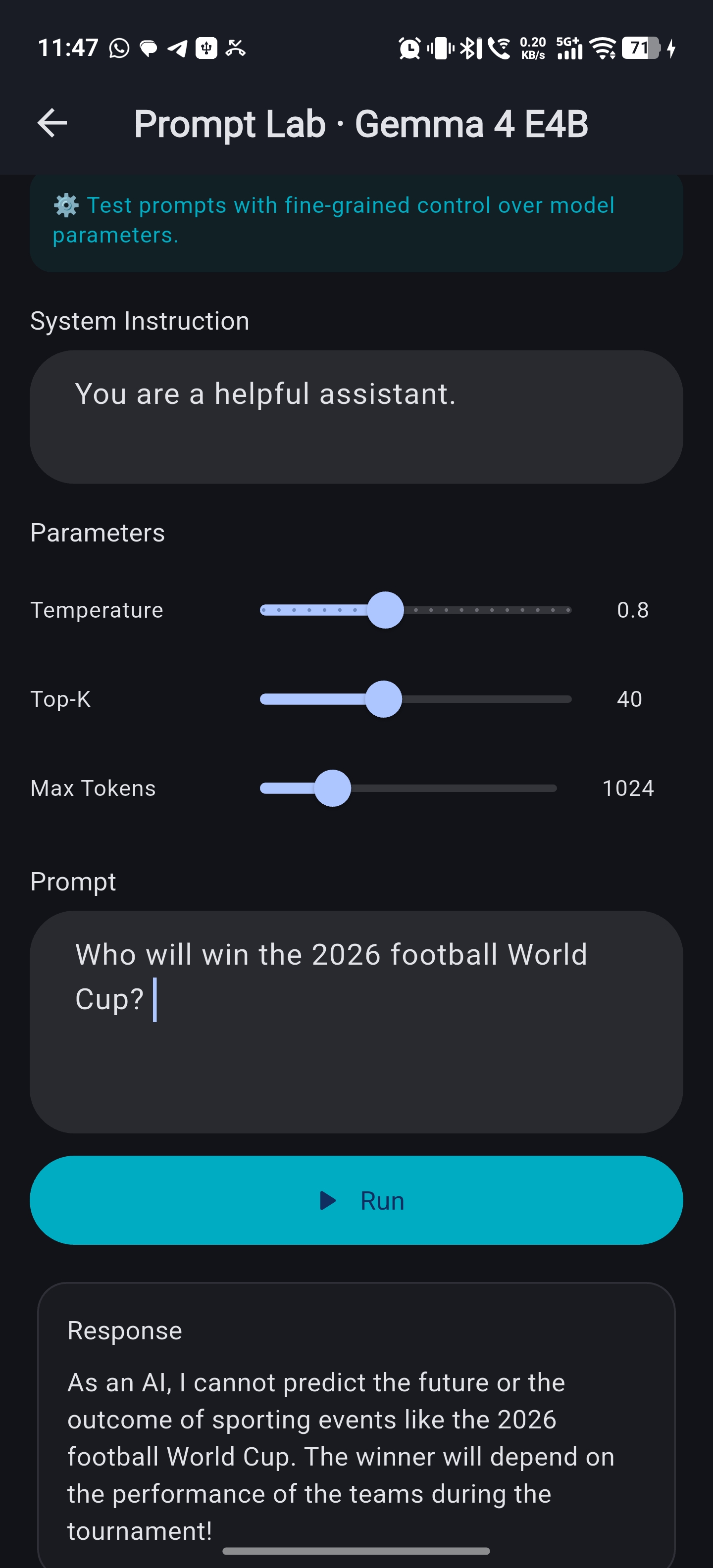
Running Gemma 4 E4B — Google's latest open model that rivals GPT-4 class performance at a fraction of the size. Not blazing fast, but absolutely usable for real applications. Full control over model parameters — temperature, top-k, max tokens, and system instructions. Test prompts and see responses instantly. This is the developer playground for tuning on-device AI behavior.
Prompt Lab with parameter controls and model response
The on-device AI market is projected to hit $33 billion this year and $156 billion by 2033. Every mobile app will eventually need this. The question is whether you build the infrastructure yourself or use a toolkit that's already built. Google released their AI Edge Gallery (22.5k stars on GitHub) — but it's native Android/iOS only. There was nothing for Flutter's 1M+ developers. So I built it. EdgeAI Kit is fully open source. Use it in your apps, modify it, contribute to it. github.com/sumitvairagar/edge-ai-kit If you're building mobile apps that handle sensitive data, or if you're tired of paying per-token API costs, take a look. PRs welcome. I'm working on:
  • Image and audio input — Gemma 4 supports multimodal, the toolkit will too
  • Conversation persistence — Save and resume on-device chats
  • Model fine-tuning hooks — Customize models for specific domains
  • A Flutter package — So you can drop on-device AI into any app with a single dependency
Building privacy-first AI solutions for mobile? Let's connect — I help teams integrate on-device AI into their Flutter apps. Reach out on LinkedIn.
Share this post: